GPT-5.6 Pricing Breakdown: Sol, Terra, Luna Token Costs & Cache Discounts
Complete cost analysis of OpenAI's GPT-5.6 series — Sol, Terra, and Luna token pricing, 90% cache-read discounts, and tier-stacking routing strategies to cut API spend by 80%.
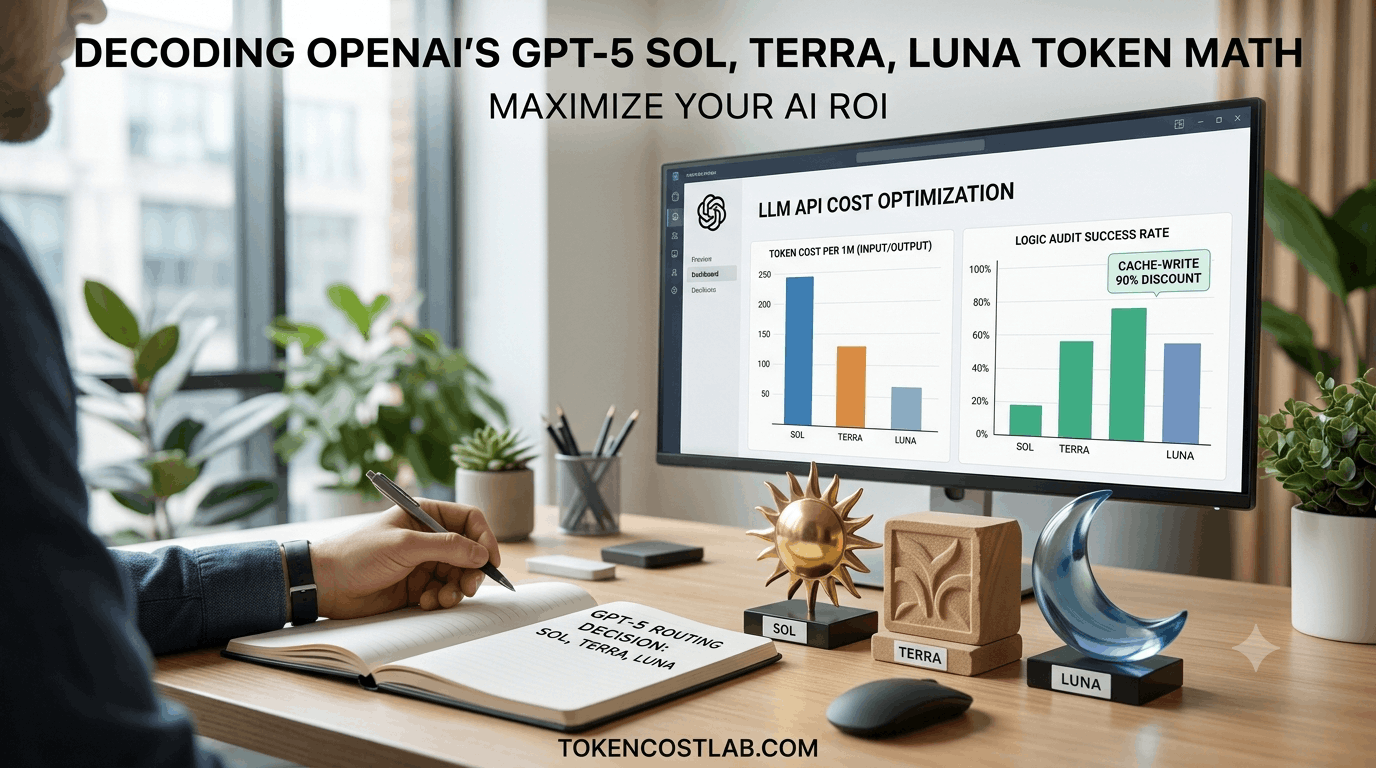
TL;DR OpenAI’s GPT-5.6 series introduces three model tiers — Sol ($5/$30 per 1M tokens), Terra ($2.50/$15), and Luna ($1/$6) — with a landmark 90% cache-read discount on all tiers. By tier-stacking your API routing (Luna for bulk traffic, Terra for daily chat, Sol for complex escalation), engineering teams can cut total LLM overhead by up to 80% without sacrificing output quality.
The wait is officially over. Following brief regulatory pauses and monumental industry anticipation, OpenAI has rolled out its highly anticipated next-generation family: the GPT-5.6 series.
Instead of dropping a single massive model, OpenAI has split the generation into three distinct tiers: Sol (the flagship powerhouse), Terra (the everyday workhorse), and Luna (the hyper-fast utility model).
For AI engineers, CTOs, and financial ops teams, this launch fundamentally rewrites the rules of LLM unit economics. It introduces unprecedented intelligence, but more importantly, it marks the debut of OpenAI’s first-ever cache-write pricing and an incredibly aggressive attack on the token-cost Pareto frontier.
Here is your definitive technical breakdown of the GPT-5.6 series performance upgrades, token consumption architecture, and the architectural “tier-stacking” strategies you need to maximize your AI ROI.
1. Meet the Family: Performance vs. Token Cost
The headline story of the GPT-5.6 series isn’t just its raw intelligence — it’s how OpenAI is undercutting the competition on price.
Independent benchmarks from Artificial Analysis show that the flagship model, GPT-5.6 Sol, scores a blistering 59 points on the global Intelligence Index, trailing its primary rival (Claude Fable 5) by a mere single point. However, Sol delivers this performance at approximately one-third of Fable 5’s task cost.
| Model Tier | Core Use Case | Intelligence Index | Input Cost (per 1M) | Output Cost (per 1M) | Cache Read Discount |
|---|---|---|---|---|---|
| GPT-5.6 Sol | Complex agentic workflows, deep coding, cybersecurity audits | 59 (Tops Coding Index at 80) | $$5.00$ | $$30.00$ | $90%$ ($$0.50$/1M) |
| GPT-5.6 Terra | Everyday text generation, document analysis, mainstream chat | 55 (Matches GPT-5.5) | $$2.50$ | $$15.00$ | $90%$ ($$0.25$/1M) |
| GPT-5.6 Luna | Asynchronous cron jobs, system heartbeats, basic classification | 51 | $$1.00$ | $$6.00$ | $90%$ ($$0.10$/1M) |
2. Deep Dive: What Makes the 5.6 Series a Game Changer?
Extended Thinking & “Ultra” Multi-Agent Mode
GPT-5.6 models can pause and “think” significantly longer before writing an output. Instead of rushing to spit out the first tokens, the internal reasoning loop maps out structural dependencies. This is amplified by an “Ultra” multi-agent setting available in the API, where specialized sub-agents collaborate behind the scenes to critique and refine responses prior to final output delivery.
Unprecedented Output Token Efficiency
Historically, more intelligence meant longer, more verbose answers that ballooned your output token costs. GPT-5.6 completely flips this script. Sol sets a new industry benchmark by using up to 54% fewer output tokens than legacy models on complex agentic coding tasks. It solves the same problems with cleaner, more concise logic.
Cache-Write Architecture
For the first time, OpenAI has standardized cache-write fees. When your system sends massive blocks of context (like entire code repositories or documentation libraries), OpenAI caches it. Subsequent requests that hit this cache receive an immediate 90% discount on input tokens.
3. The New Meta: Tier-Stacking Your API Routing
Six months ago, the standard engineering pattern was simple: choose one frontier LLM and route $100%$ of your app’s traffic to it. In the GPT-5.6 era, that approach is a financial liability.
The smartest engineering teams are shifting to a three-tiered model stack to achieve up to an 80% total reduction in API overhead without sacrificing quality.
       [ Incoming User Request / System Event ]
                         │
                         ▼
               ┌──────────────────┐
               │ Semantic Router  │
               └──────────────────┘
                         │
        ┌────────────────┼────────────────┐
        │ (85% Vol)      │ (12% Vol)      │ (3% Vol)
        ▼                ▼                ▼
┌──────────────┐ ┌──────────────┐ ┌──────────────┐
│     LUNA     │ │    TERRA     │ │     SOL      │
│ (Background, │ │ (Daily Chat, │ │ (Escalation, │
│ Cron, Tasks) │ │  Writing)    │ │ Hard Coding) │
└──────────────┘ └──────────────┘ └──────────────┘
Tier 1: Luna as Your Application Heartbeat (~85% of volume)
At $$1/$6$ per million tokens, Luna is more cost-effective for output tokens than even DeepSeek V3.2, yet boasts higher native contextual quality. Use Luna for background indexing, telemetry processing, metadata generation, and system cron triggers.
Tier 2: Terra for User-Facing Conversations (~12% of volume)
Terra gives you the heavy-duty reasoning capabilities of the older GPT-5.5 flagship but cuts the input/output cost clean in half. It is the perfect default picker for chat interfaces, content drafting, and interactive data visualization.
Tier 3: Sol for On-Demand Escalation (~3% of volume)
Do not burn your budget running basic queries through Sol. Instead, program your system to escalate tasks to Sol only when a lower-tier model encounters a logic error, or when a user explicitly initiates a complex automated feature like an end-to-end codebase refactor or defensive cybersecurity scan.
4. Developer Pro-Tips for Optimizing GPT-5.6 Cost
- Warm the Cache Continuously: Because input caching cuts costs by $90%$, prepend your system prompts with static historical context or schema definitions. Keep these blocks identical across API calls to ensure your hit rate stays above $80%$.
- Enforce Output Constraints via System Prompts: Since GPT-5.6 is highly compliant and naturally concise, explicitly instruct the model to “Provide the minimum required code/text to solve the problem without pleasantries.” This leans into its natural token-efficiency, shaving off even more output expenses.
- Handle “Extended Thinking” Timeouts: Because Sol takes longer to evaluate multi-step problems, ensure your backend gateway timeout limits are adjusted higher (we recommend at least 15–20 seconds read timeout) to prevent premature connection drops during deep reasoning events.
Audit Your LLM Spend Automatically
Navigating multi-model routing across Sol, Terra, and Luna can get complex quickly.
[Use TokenCost Lab’s GPT-5.6 Cost Simulator] to paste your actual prompt logs, instantly model your potential savings with OpenAI’s new 90% cache discounts, and deploy an optimized routing layer today.